
Slotbound Winning Lines and Payouts: How Scoring Works
How Slotbound pays out: eight possible lines on a 3x3 board, why multiple lines stack in one spin, and how nudges and blasts turn a near miss into a summon.
A payout in Slotbound is a completed line, and a completed line is a summon. A 3x3 board can hold at most eight straight lines, pays every line that completes in the same spin, and turns a four-line spin into four summons instead of one. There is no published payout table, so the practical skill is stacking lines and using nudges to finish pairs you already have.
Slot machine vocabulary promises a paytable. Slotbound does not have one, at least not in the sense a casino player expects: you are not collecting coins from a symbol match, you are collecting bodies. The board pays in army, and the army is what defends the field. Once you reframe payouts that way, the three achievements built around lines stop looking arbitrary and start reading like a tutorial.
What counts as a winning line
Three matching symbols in a straight line. On a 3x3 grid that means:
| Line type | Count | Notes |
|---|---|---|
| Rows | 3 | Easiest to complete with a nudge, because a nudge moves a reel |
| Columns | 3 | The line you read before you pull, because columns share a reel |
| Diagonals | 2 | Same value as any other line, no bonus for rarity |
| Total | 8 | The mathematical ceiling for a single spin |
Every completed line summons. Nothing in the store text or the achievement list suggests a line pays gold, and the gold counter is driven by waves and by items, not by the board. So the correct mental model is: lines are unit slots, not money slots.
Why multi-line spins matter more than rarity
The achievement list is unusually explicit about this. Four Lines asks for four or more winning lines in a single spin, and it sits at 50.2 percent global unlock, which means half of all players have done it. Baby Boomer asks for eight or more units summoned from one spin and sits at 16.5 percent.
Those two numbers describe the same skill at two levels. Getting four lines is achievable on a normal board if you use a nudge well; getting eight units from one spin needs a board where several lines finish at once, or a jackpot that fills the screen.
A four-line spin is not four times a one-line spin in value, because the army cap limits how many units you can hold. It is four times the absorb material, which matters more, because material is what raises stars.
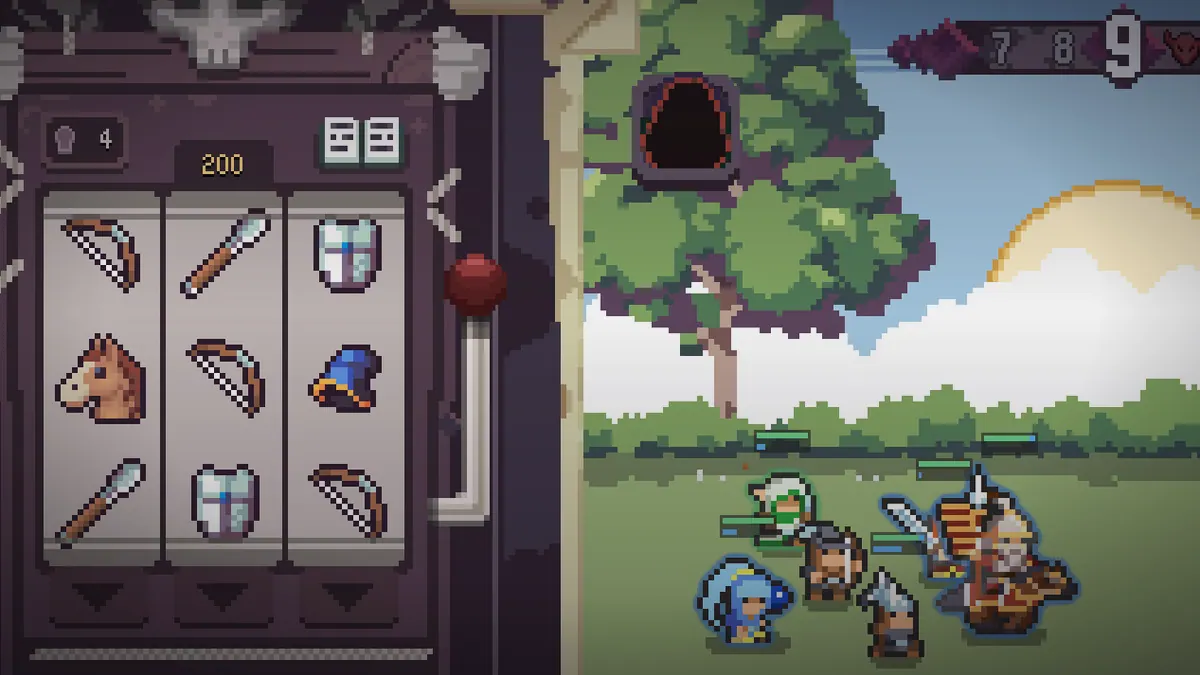
The nudge payout
Nudges shift a reel by one step, and the achievement God of Nudges asks for three or more winning lines from a single nudge. That is the single clearest statement of how the mechanic is meant to be used: a nudge is not a reroll, it is a line finisher.
The decision rule:
- Nudge when two lines are one symbol away. A nudge that completes two lines is worth more than a re-spin, because it costs one input instead of a full spin.
- Nudge when the move creates a pair for the next spin. Even a nudge that completes nothing can set up a column with two matching symbols, which is a real gain.
- Do not nudge to chase a symbol with no partner. One-in-three odds with a price is the worst trade on the board.
The full economics, including when a bought spin beats a nudge, are in the nudge and re-spin guide→.
Blasts: paying with symbols instead of spins
Perfect Demolition asks you to remove six or more symbols with a single blast, and it sits at 7.3 percent, which makes it one of the rarer line-adjacent achievements. A blast clears symbols from the board, and clearing symbols is the only way to change a board without spending a spin or a nudge.
That makes blasts a setup tool. A blast that removes six shields so that three bows line up is worth more than a blast used to clear clutter at random. If you are chasing Four Lines or Baby Boomer, blasts are the missing piece: they let you manufacture a board where several lines can finish on one spin.
What rarity adds to a payout
Normal lines summon Normal-grade units. Legendary results come from high-value lines and jackpots, and the legendary Prism unit is named on the store page as the jackpot summon. Special rarity exists as well, added with Jester in version 0.4.0.
The unlock rates put this in perspective. A Legend Appears, the achievement for summoning a legendary, sits at 6.1 percent. That is one in sixteen players, which is a rare event rather than a build plan. Payout strategy should be built on line frequency and absorb value, not on chasing rarity.
A worked example
You are on wave 6 with a cap of 7 and four units deployed. The board shows:
- Column one: bow, shield, bow.
- Column two: shield, shield, staff.
- Row three: staff, shield, bow.
Before the spin, two columns have a pair and one row has a pair. Any bow in column one completes a line; any shield in column two completes a line; any shield in row three completes a line. That is three live lines from a single board state, and no other decision in the game offers that much leverage for free.
That is what a paytable looks like in Slotbound. It is not a table of numbers, it is a table of pairs you are waiting to finish.
Sources
Official source: Slotbound on Steam ↗
- Steam store page ↗ for line matching, the 3x3 machine and the jackpot description.
- Steam achievement stats ↗ for Four Lines, God of Nudges, Baby Boomer and Perfect Demolition rates.
- Steam Community hub ↗ for player-posted screenshots of multi-line spins.
FAQ
Do diagonal lines pay more in Slotbound?
No. A line is a line. The only difference between a diagonal and a row is that a row is easier to nudge into place, which makes diagonals harder to complete rather than more valuable.
Can one spin complete all eight lines?
Only by filling the entire 3x3 grid with matching symbols, which is effectively a jackpot board. The realistic ceiling for a normal spin is two to four lines, which is exactly the range the Four Lines achievement targets.
Do winning lines give gold?
No. Lines summon units. Gold comes from waves and from items, and it is spent on upgrades and bought spins. Treating the board as a money slot is the most common misread of the game.
What happens if a line summons more units than my cap?
The units beyond your cap are the ones you feed into a carry. That is why raising the cap early is valuable: it converts line results into army strength instead of absorb fodder you did not need yet.